
Tennis Swing Analysis from Phone Video
The swing does not begin at contact. It does not end there.
Analyze a tennis swing from ordinary phone video. SpatialForm reveals timing, balance, contact, recovery, and next-ball readiness through 3D Performance Form.
A stroke can look successful at contact while the movement behind it is already breaking down. The player may have prepared late, arrived off balance, or recovered too slowly to be ready for the next ball.
SpatialForm looks beyond the visible result of the shot—and into the movement sequence that produced it.
What Tennis Swing Analysis Should Reveal
A useful swing analysis should explain more than the contact frame.
A tennis stroke is not one isolated moment. It is a connected movement sequence. A replay can show the stroke. A deeper analysis should show how the stroke was built.
Preparation
Did the athlete begin organizing the stroke early enough?
Timing
Did loading, rotation, and acceleration happen in a usable sequence?
Contact
Did the athlete arrive in a position that supported the shot?
Balance
Did the body remain organized through and after contact?
Recovery
Did the athlete return to a state that supported the next ball?
The Missing Cause
A clean contact can hide a broken sequence.
The ball lands deep. The stroke looks complete. The replay appears normal. But the problem may have begun before the racket accelerated.
Late preparation can delay the entire action. A weak first movement can force the athlete to reach instead of arrive. Contact can still happen—but from a position that is difficult to balance, recover from, or repeat.
The ball shows the result. The athlete shows the cause.
Analyzing the ball alone can leave the cause untouched. To improve the stroke, you have to understand the movement that produced it.
From Replay to Performance Form
Watch the athlete emerge from the video.
A normal replay shows the court, the ball, and the final stroke. SpatialForm brings the athlete-side movement forward. From ordinary phone footage, the movement is presented as a 3D Performance Form so preparation, timing, balance, contact, and recovery can be inspected as one connected sequence.
Ordinary phone video → athlete movement → 3D Performance Form
From Phone Video to Movement Evidence
The movement is already inside the video.
SpatialForm does not ask the athlete to begin with a laboratory. It begins with the type of video players already record and turns that recording into a movement-review process.
-
01
Upload the video
Start with ordinary phone sports video. No motion-capture studio, body-mounted sensors, or specialized court installation.
-
02
Reveal the athlete movement
SpatialForm brings the athlete-side action forward from the replay, so preparation, loading, acceleration, contact, and recovery no longer remain buried inside a normal video.
-
03
Build 3D Performance Form
The stroke becomes a reviewable 3D Performance Form instead of being limited to one camera angle or one frozen frame.
-
04
Read the movement evidence
Timing, balance, loading, contact, power transfer, and recovery can be reviewed as connected movement evidence—not only as impressions.
Phone Sports Video → 3D Performance Form → Movement Evidence
The Questions Replay Leaves Unanswered
A replay gives you the stroke. Performance Form helps answer the question.
Athletes do not need another wall of numbers. They need to know what happened, where it began, and what movement evidence they can inspect.
01 · The Frame You Never See
“My coach says fix your form. I still can’t see what’s wrong.”
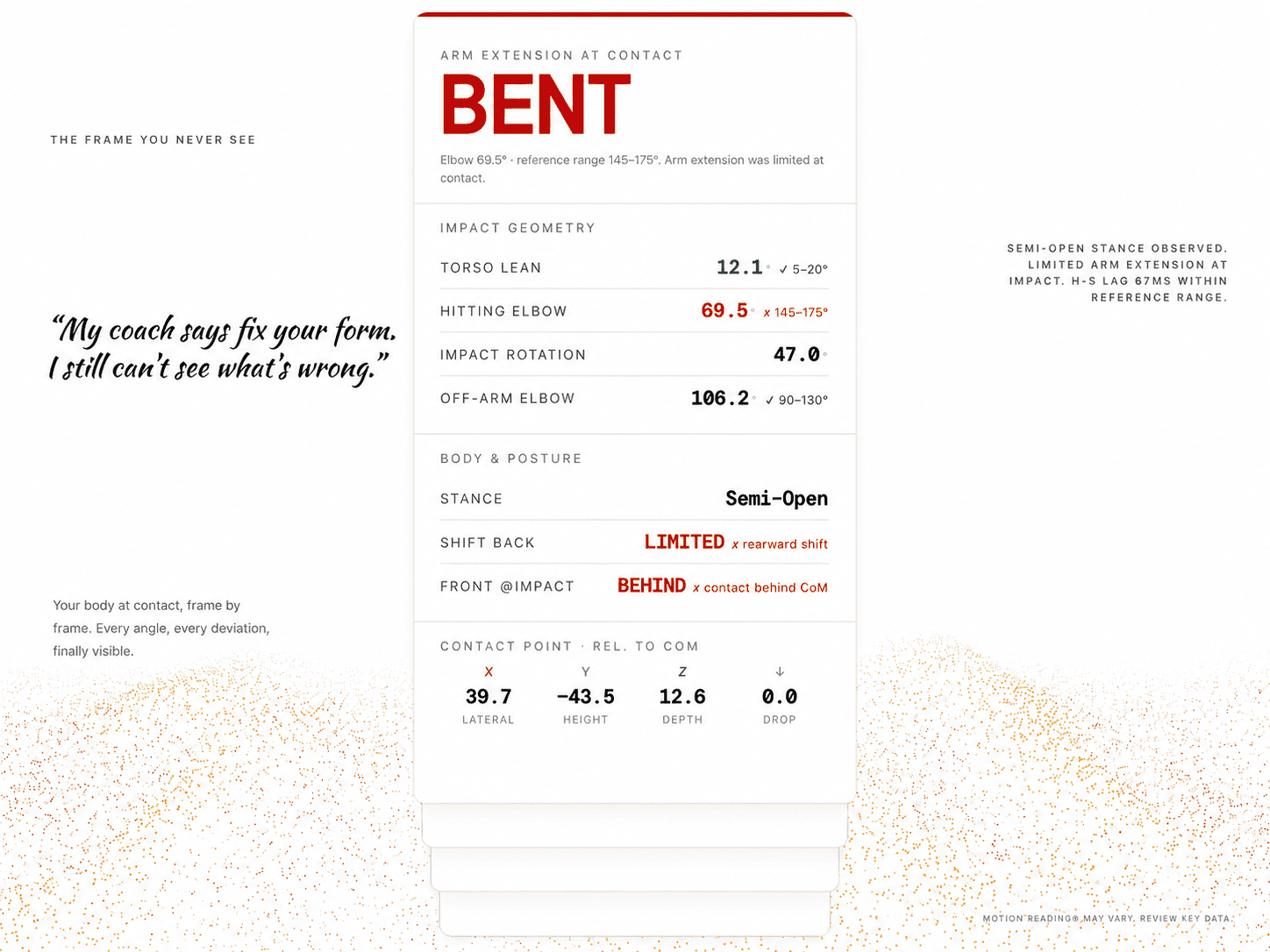
Turn a broad correction into visible contact structure.
A broad instruction can be correct and still be difficult to use. Players are often told to fix the form, get more extension, or arrive better at contact. But replay alone does not always make the problem visible.
Performance Form helps turn a vague correction into inspectable movement evidence. Contact can be reviewed through the body organization that produced it: arm extension, hitting-arm structure, torso lean, stance, contact location, and balance at impact.
The goal is not to replace the coach. It is to make the body at contact easier to inspect—so the athlete can finally see what “fix your form” actually points to.
- Arm extension
- Hitting-elbow position
- Torso lean
- Stance
- Contact position relative to the body
- Balance at contact
Your body at contact, frame by frame. Every angle, every deviation, finally visible.
02 · Frame Analysis
“The real problem starts in the frame you never notice.”
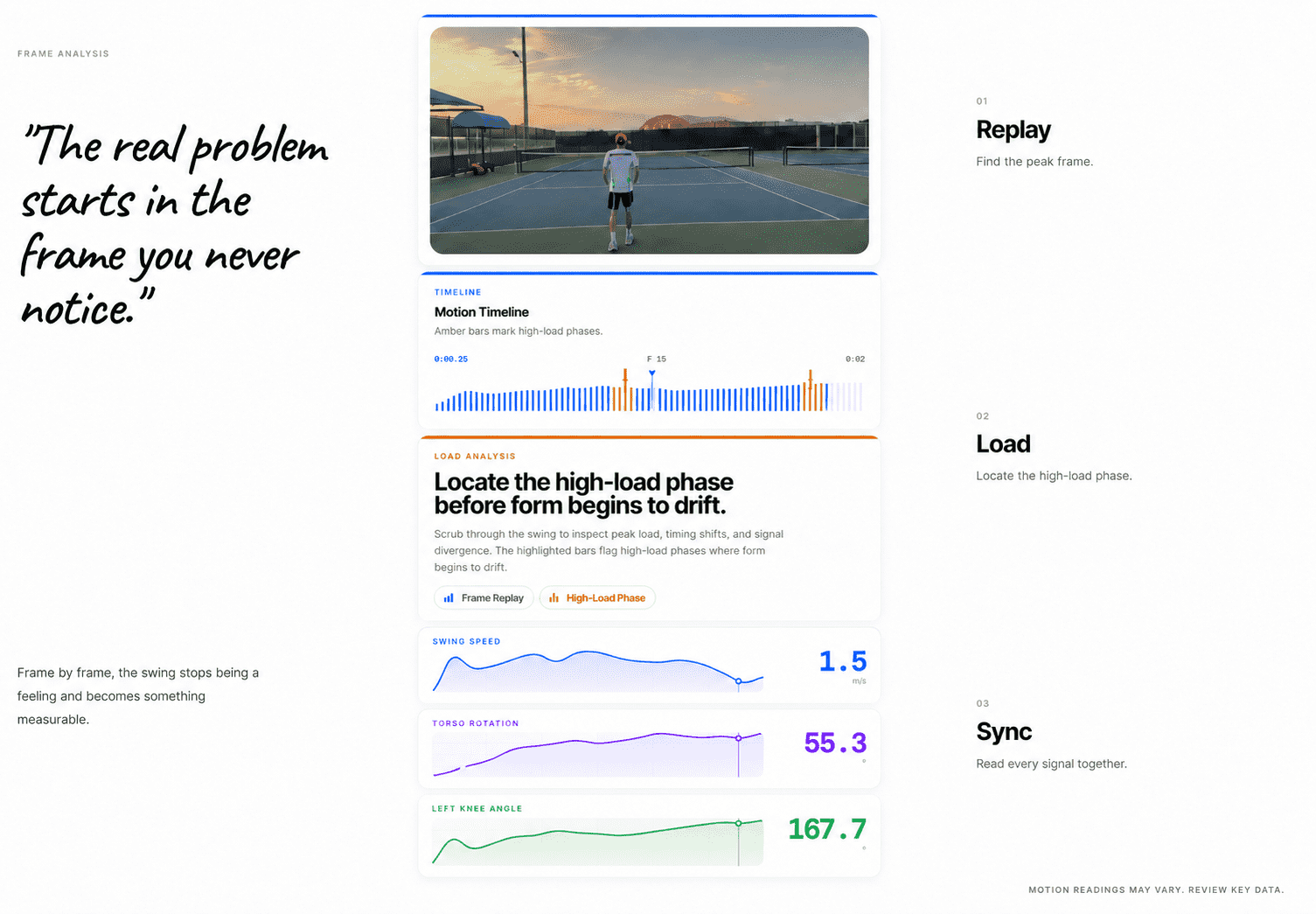
Find the frame that created the visible mistake.
A visible mistake often appears late. By the time the player notices that the stroke felt wrong, the ball may already be gone.
The actual breakdown may have begun earlier—during loading, during timing drift, or in the first part of the sequence that ordinary replay does not isolate clearly.
By connecting replay, load analysis, and synchronized movement signals, Performance Form helps locate where the stroke started to go off track—not only where contact happened.
- Frame replay
- Motion timeline
- High-load phase
- Timing shift
- Signal synchronization
- Form drift
Frame by frame, the swing stops being a feeling and becomes something measurable.
03 · Your Legs Tell the Truth
“I know I should push off. I don’t know if I actually do.”
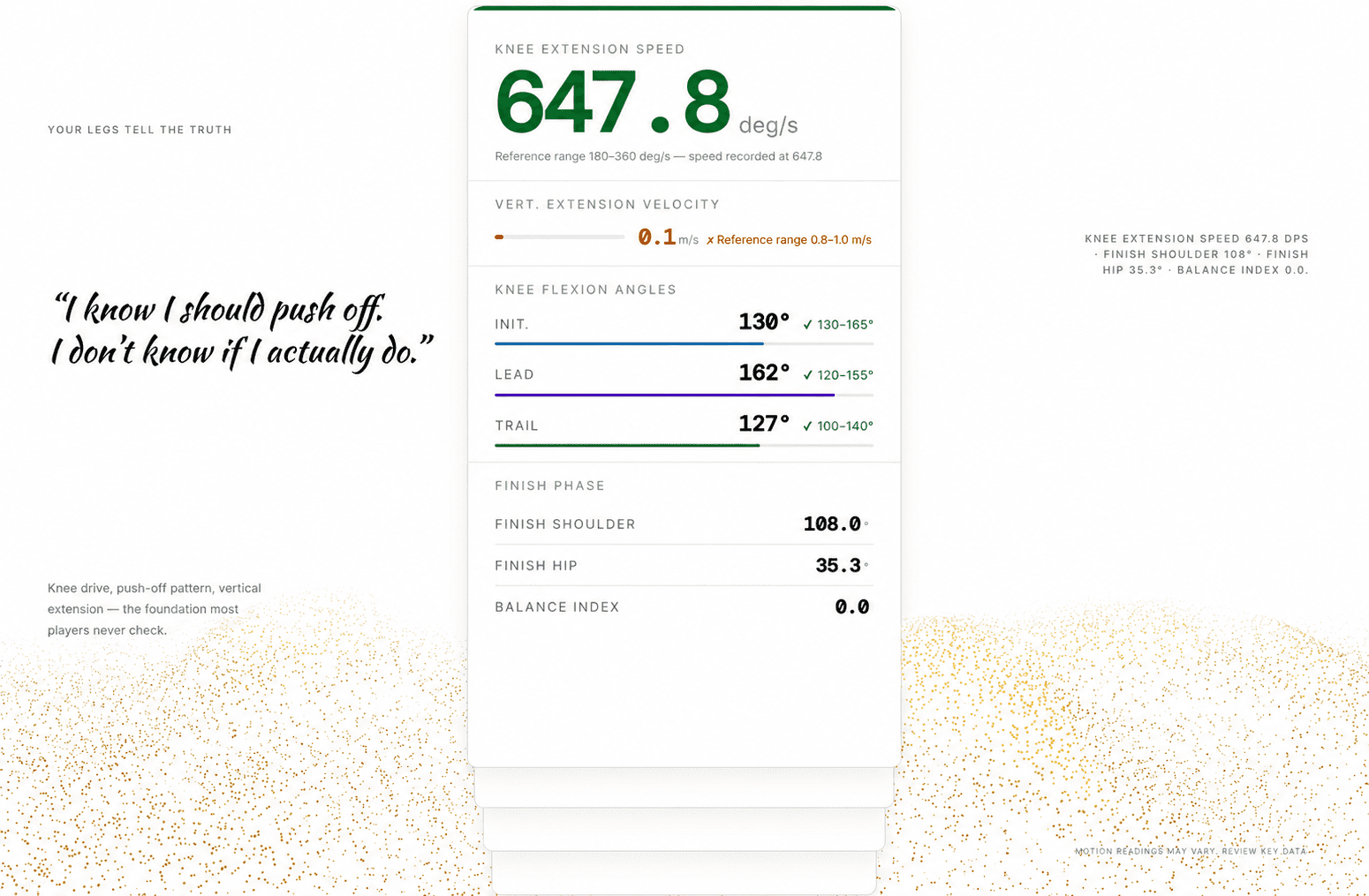
See whether the lower body supported the stroke—or only followed it.
Most players understand the instruction: use the legs, push from the ground, and stay balanced through the stroke.
But understanding the cue is different from seeing whether the lower body actually contributed the way the athlete believes it did. The upper body can finish the stroke even when the legs provided too little support, drive, or vertical organization.
Performance Form brings that lower-body evidence into view and turns “use your legs” from a general instruction into a movement process the athlete can inspect.
- Knee extension
- Push-off pattern
- Vertical extension
- Finish-hip position
- Finish-shoulder position
- Balance through the finish
Knee drive, push-off pattern, vertical extension—the foundation most players never check.
04 · Your Power, Measured
“I swing hard. Where does the power go?”
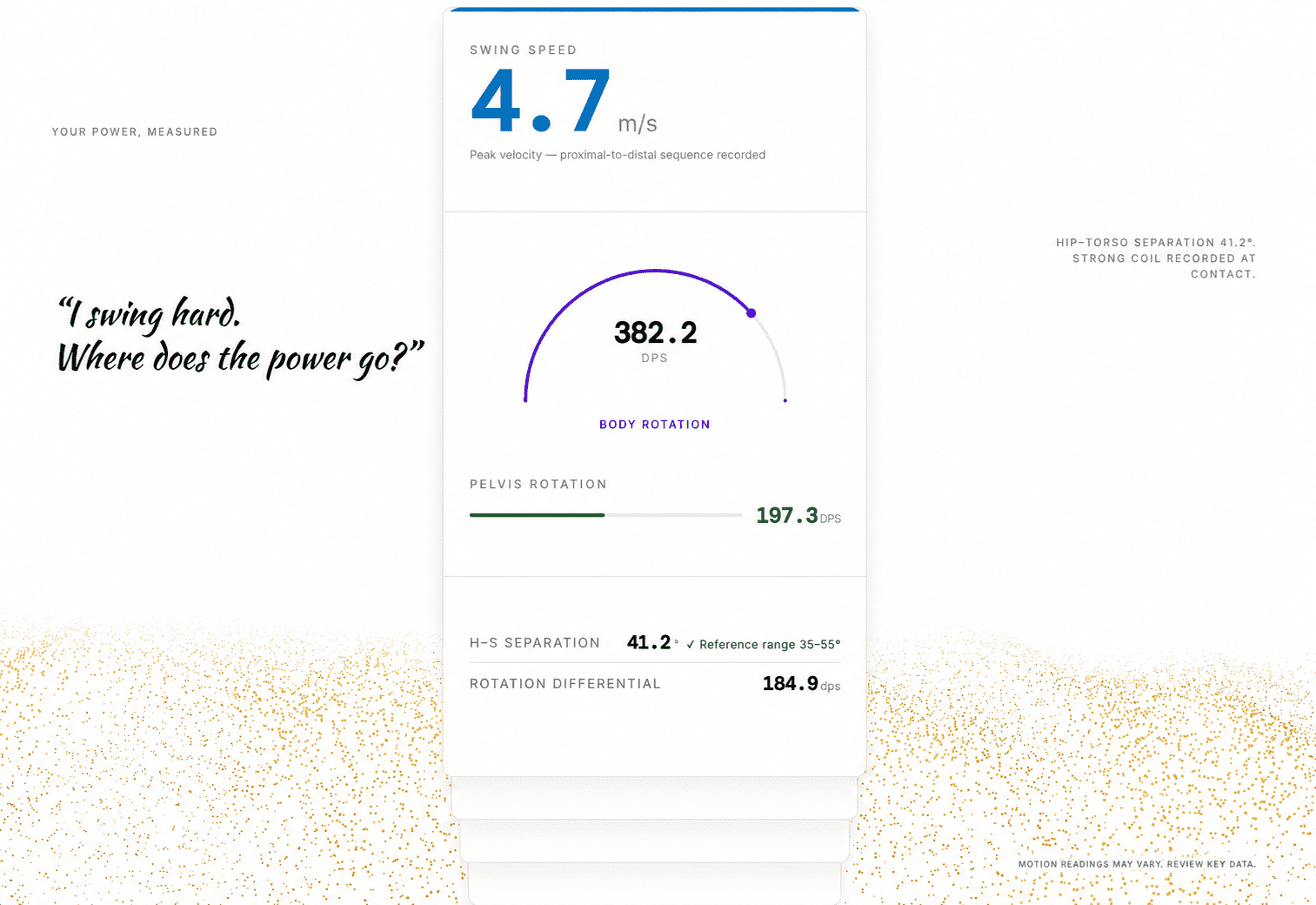
Separate effort from movement transfer.
Effort is not the same as transfer. A player can swing aggressively and still lose power through the sequence.
The racket may move fast while pelvis rotation, torso rotation, and upper-body timing remain poorly connected. The athlete feels effort without getting the strike they expected.
Performance Form helps examine where power is organized, transferred, or lost by connecting swing speed with the movement sequence that produced it.
- Pelvis rotation
- Torso rotation
- Hip–torso separation
- Rotation timing
- Proximal-to-distal sequence
- Transfer into the hitting arm
Power is not only speed. It is how movement travels through the athlete.
05 · Why Your Timing Feels Off
“The ball feels right. Then it’s gone.”
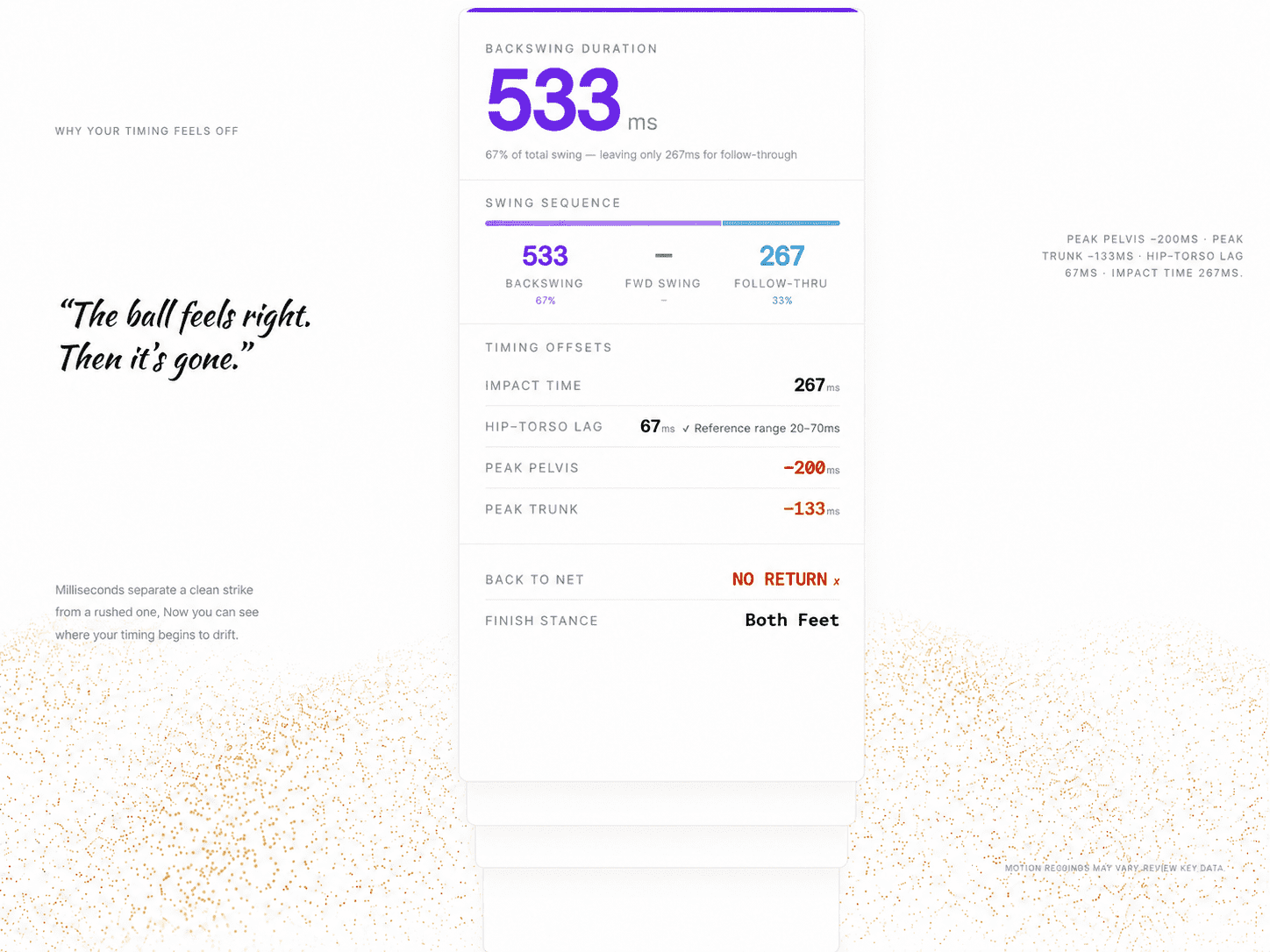
Make timing drift visible.
Timing problems often live in very small windows. The player may feel almost right—only a little late, rushed, or unstable—without knowing where the drift began.
A backswing that lasted too long, a delayed transition, or a mistimed trunk sequence can all create a shot that feels close but disappears before the athlete can organize it.
Performance Form connects timing numbers to movement the athlete can see, so milliseconds become evidence instead of abstract data.
- Backswing duration
- Forward-swing timing
- Impact time
- Pelvis timing
- Torso timing
- Hip–torso lag
- Finish stance
- Return state
Milliseconds separate a clean strike from a rushed one. Now you can see where your timing begins to drift.
Next-Ball Readiness
“I made contact. Why am I still late for the next ball?”
The stroke continues after the ball leaves the strings.
The athlete still has to finish in balance, begin recovery, re-enter a useful court position, and become physically available for the next action. A successful shot can still leave the athlete late.
- Contact balance
- Finish position
- First recovery movement
- Recovery lag
- Court re-entry
- Next-Ball Readiness
Shot tracking explains the ball. Performance Form explains whether the athlete was ready for the next action.
One Swing. One Connected Movement Structure.
These are not separate problems.
Form at contact, the frame before the mistake, leg contribution, power transfer, timing drift, and recovery are different windows into the same stroke.
A reviewable 3D structure of how the athlete organized the action.
Performance Form connects movement across time and space. It is not one isolated score, one contact screenshot, one ball path, or a set of unrelated measurements. It connects the action from preparation through recovery and readiness.
- Phone Sports Video: The movement evidence athletes already record.
- 3D Performance Form: A reviewable representation of how the athlete organized the action.
- Personal Athletic Intelligence: A clearer way to understand movement and change over time.
Built for the Video You Already Have
No laboratory. No body-mounted sensors.
SpatialForm begins with ordinary phone sports video. No motion-capture studio, straps, wearables, or specialized court installation.
Useful movement understanding should not remain limited to professional laboratories or elite performance departments. It should begin with the camera already in your hand.
Tennis Swing Analysis Should Answer the Athlete’s Question
Your video contains more than a swing.
Inside every stroke is a sequence of preparation, timing, balance, force transfer, contact structure, recovery, and readiness. SpatialForm turns that sequence into a 3D Performance Form that can be inspected—not just replayed.
For the complete SpatialForm product system, methods, and capabilities, continue to the official SpatialForm page.
Discover SpatialForm · Explore Performance Form
Personal Athletic Intelligence from phone sports video.